The Witch
Rating: 9.5/10
We can’t talk about horror without talking about its erosion. It’s a sad reality: when movies like The Babadook and It Follows come along as near-perfect examples of the genre, we can’t praise a single thing about them without almost obligatorily commenting on just how poor the surrounding dreck really is. So these days, when an entity like the Satanic Temple publicly announces their support of a horror movie, it’s a bigger deal than it might have been in the genre’s heyday sometime in the 80s. You can't help a little cynicism and suspect it's for the publicity, especially when the film in question is pitted against a so-called "faith epic," Risen, to be released the same day. On the other hand, we should keep in mind the track record of A24, the studio behind The Witch: from the hard sci-fi of Ex Machina to the restrained period drama of A Most Violent Year, the studio has been on a roll with elegant, well-assembled feature films spanning a respectable range of genres. Add to that some lively festival buzz stretching back over a year, and at the very least, one must wonder if there is something more to The Witch than the average horror effort after all.
There damn well is.
It’s easy to see why the Satanic Temple was so quick to back Robert Eggers’s debut: although the devil is very much a player in the events of the film, the fact is that, for the better part of The Witch, the true enemy is Catholicism. If we want to go a step further, we can say that it’s really the belief in the devil, not so much Old Scratch himself, that antagonizes the colonial family at the heart of the movie, and it wouldn’t be a stretch to argue that perhaps there isn’t a single devil in the film. But there's a witch. There may even be several. There may be none. It seems to me that the “witch” of the title doesn’t refer solely to the cackling things we see in the first fifteen minutes or the last, to the seductress waiting in the film’s supremely menacing New England forest, or even to the accused Thomasin, the film’s heroine (of sorts). What the title refers to, and what the film is most concerned with, is the belief in malignant evil as it operates through the reality of witchcraft and the archetypal “witch”: a silly impossibility to us, but a deadly and literal reality to Thomasin’s family.
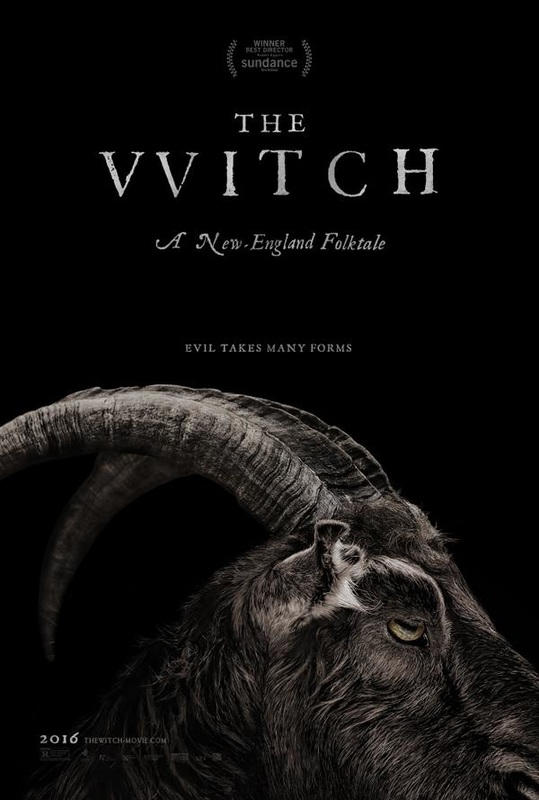
Early in the film, as William and Caleb are out setting traps, William asks Caleb to discuss his “natural state of evil.” Caleb is a boy no older than eleven. The worst we see him do for sure is lie to his mother. Yet he explains with rote efficiency, as he is taught to do by his father and his father’s Puritan religion, his inherently sinful nature; that all he thinks and does, and all he is, is subject to and deserving of eternal punishment. This is the mindset The Witch places us inside, and from where its horror chiefly derives. He, like his family, believes he is destined for hellfire, that the devil waits around every corner and is not merely some boogeyman but a living, cunning, hateful thing bent on their destruction. It stares from the eyes of a hare. It haunts their property as a black, smiling goat. And because he believes - because his family believes - it is so.
There is no escaping hell in the world of The Witch because Thomasin’s family are born into it and must suffer their way out. Life is a nightmare, and our sympathy for the characters is partly pity as a result - pity for their ignorance. When Caleb returns stumbling, shivering, and lockjawed from an encounter with the witch in the woods, the family’s first thought is not pneumonia or disease at all, but witchcraft. And when they turn to prayer, the only medicine they know, and that prayer proves ineffectual, the spiritual anguish that descends on them is more horrifying than any monster Eggers can show us. Caleb doesn’t escape, and neither does Thomasin - but her fate is arguably the better one. Sure: on the surface, she seems to opt out, choosing to join what she can’t beat. It plays almost like a betrayal. It’s far more than that. Her conversation with Black Philip will go down as a legendary moment in horror film-making - it had the same effect on Alex and I that I think Father Merrin’s encounter with Regan in The Exorcist must have had on audiences in 1973, which is to say, almost rapturous terror - but the moment Thomasin drives a blade into her mother’s throat, and then keeps driving it, is when The Witch clicks. Thomasin’s decision is really the only one her family’s lifestyle leaves her. She chooses freedom.
I think there’s all sorts of ambiguity to the last reel of the film. I’m not convinced that what we see isn’t partly, maybe even totally, Thomasin’s fantasy. There is an overwhelming focus on her face and the pitch-black negative space all around her, suggesting that what we see, and what we think we see, is inside her head. At the same time, there is a literality to the entire film, a staring documentary quality to the cinematography and an unnerving authenticity to the 17th century dialogue that lends itself just as easily to opposing interpretations. It’s my conviction that the only evil at work here is, again, only the belief in evil. This isn’t a siege story about a family succumbing to a witch coven. It’s a tragedy, first and foremost, about a group of deeply paranoid and suppressed individuals combusting with the psychological pressures of religious zealotry and frontier survival.
The Witch is where horror needs to go.
-Brian L.
Archival details
- Original URL
- https://metallifestyle.weebly.com/curtains-movie--tv-reviews/review-the-witch
- Recovery source
- live-weebly
- Recovery date
- 2026-07-22
- Stewardship polish
- 2026-07-22
- Preservation status
- restored
- Missing assets
- None recorded
Preserved by Bloodsoaked Media · The Archives