The singing is out of tune, but look: Uneven Structure consists of a drummer, a bassist, a guitarist, a guitarist, a guitarist (that’s right, three of them), and lastly, a vocalist. After its six-year gestation and in the face of its carefully refined craft, this grievance with Mathieu Romarin’s voice (one sixth of the music!) that has popped up in reviews of La Partition is really just a distraction from more valuable analysis. It’s true that six year have wrought some changes, the most salient one being that Romarin has altered his vocals, tipping the ratio in favor of his out-of-tune singing for a good two-thirds of the album; it could even be argued that La Partition’s production draws attention to this change by layering his vocals almost to excess, but to focus on this is to miss the forest for the trees. If none of the five other musicians in Uneven Structure objected to Romarin’s singing in six years, there’s a good chance they were okay with it. Perhaps it’s even a conscious change, one with cross-genre precedent in Ghoulgotha’s out-of-tune lead guitar: a messy component meant to shake things up in an otherwise staid, rigid genre.
That’s half an argument. There may be intention, but to what end? And does it succeed?
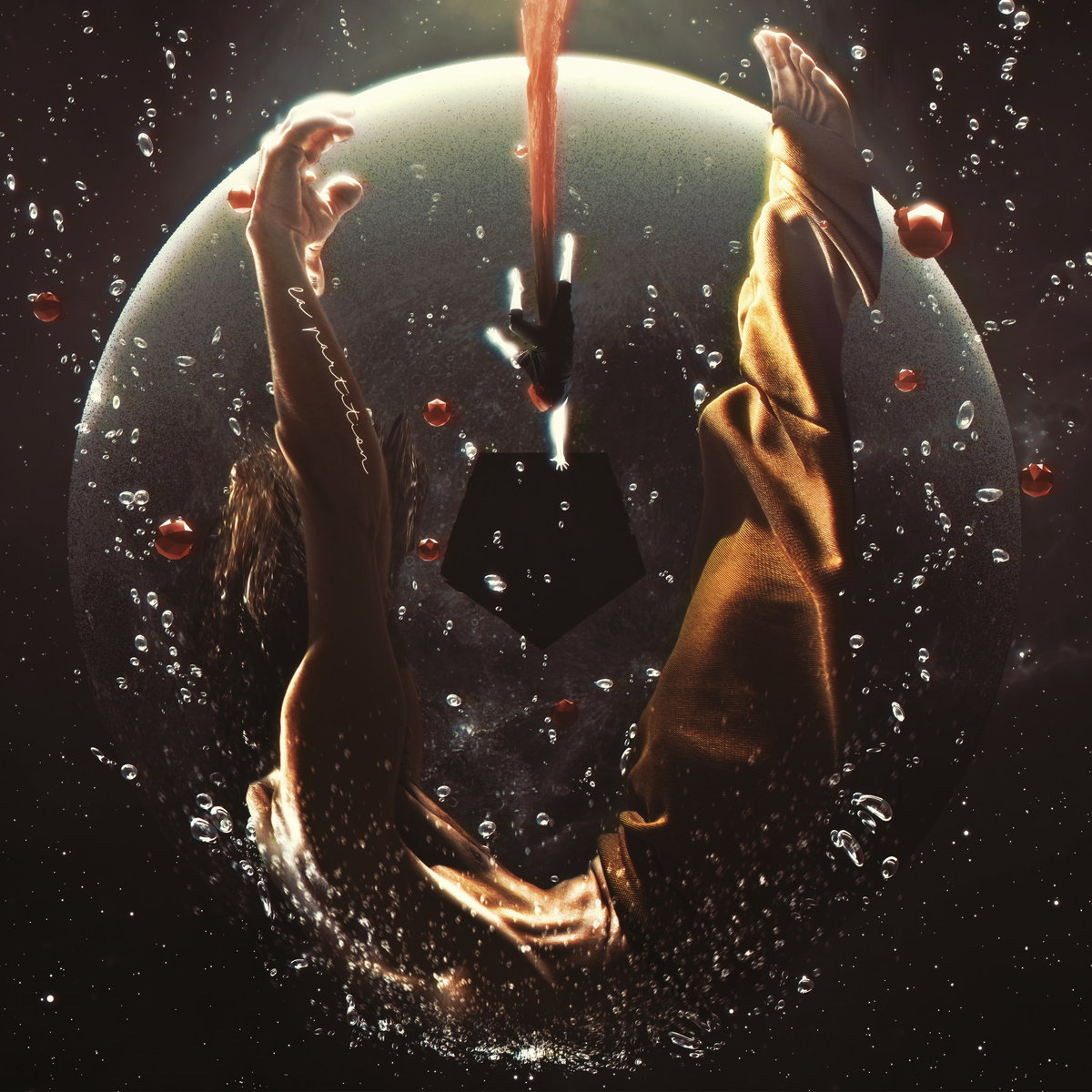
2011’s Februus is an album about spiritual awakening that sidesteps both religious subtext and New Age bullshittery. La Partition looks to explore similar ground from a different angle, beginning with its title, which is a French cognate for “partition,” the action of dividing or the state of being divided. In tandem with the cover depiction of a figure falling into (or emerging from) a glowing membrane, my impression was that the album would explore birth. Perhaps the womb is the titular partition separating us not only from one another, but also from our spiritual natures. Bubbles in the art, together with the waves decorating the inner panels of the digipak and the album’s “swimmy” production, seem to add credence to that line of thought, bringing together the amniotic fluid of the womb and the “primordial soup” of the early ocean - but the tracklist seems to tell a different, and altogether more mundane, story. I don’t put much stock in song titles, but the way the album is so carefully divided into three sections of three, separated by the interludes “Groomed and Resting” and “Greeted and Dining,” is too ripe for analysis to pass over.
So let’s start at the start. The first trio of songs is “Alkaline Throat,” “Brazen Tongue,” and “Crystal Teeth,” which visually plot a course from the inside out, as if something - the music, the listener, the unnamed figure on the cover - is being cast out or expelled. “Alkaline Throat” sees the band displaying restraint in some areas and refinement in others: it may trade the mystery and grandeur of Februus’s “Awaken” for punchy immediacy, but repeated listens reveal the elaborate layering that was key to Februus’s enduring appeal. In the past, it could be difficult to tell Uneven Structure’s three guitarists apart, but their roles are better defined on La Partition. Generally, two syncopate until one breaks into more adventurous riffing, while the third guitar cranks out ambient effects, utilizing what must be really cumbersome pedal boards. Romarin flexes his newfound range from the get-go, ripping some growls as the song draws to its end, where they feel deserved. With two minutes over the opener, “Brazen Tongue” deepens the ambience and rhythmic complexity, throwing in some showy stop-start patterns over which Romarin’s vocals get a chance to soar. The song rolls through muted ambience and polyrhythmic metal with aplomb, crescendoing into “Crystal Teeth,” where the bassy production provides a lush, rounded tone as the band indulges some Tool-isms. As the song stacks spacey riffs and Romarin’s subdued melodies, it’s easy to detect the influence of Deftones’s Koi No Yokan, a strand of La Partition’s DNA that will mutate a little later on.
The song ends on a dark note and moves into “Groomed and Resting,” thirty-nine seconds of intensifying static and...noises. Whatever’s going on, it provides a suitably uncertain resolution to “Crystal Teeth” and transitions us into the middle portion of La Partition. As “Brazen Tongue” does for “Alkaline Tongue,” “Incube,” “Succube,” and “Funamble” build on one another, elaborating on motifs or taking established quirks in unexpected directions. “Incube,” also released ahead of La Partition, layers ghostly moans, tick-tocking riffs, and cyclical drumming into a witchy slow-burner that seems to shift tone every bar. It even flirts with a major key around the three minute mark, until some wicked growls and droning chords shut it down, only to be robbed of a climax themselves by the even eerier “Succube.” This song uses all the same pieces as “Incube” to more urgent effect, turning the ominous riff at 2:34 into a groove that harkens back to Februus’s heavier moments. The track ends with a plea - “What more do you want from me?” - that sets the stage for “Funambule,” the album’s heaviest song and a preview of what’s to come. Credit Uneven Structure’s songwriting that the change of tone doesn’t feel sudden or arbitrary in the least, as the album has been ratcheting up the tension since “Crystal Teeth.” All those bursts of aggression along the way begin to pay off, and what the song sacrifices in dynamics, it more than makes up for in riffs and the full use of Romarin’s improved growls.
“Greeted and Dining” stretches to nearly two minutes of threatening formlessness before “The Bait” drops in. I’d be lying if I said the gloomy instrumentation doesn’t ache of Katatonia (filtered through djent, of course), and it’s of comparable length and tone to much of what’s found on last year’s The Fall of Hearts, but there’s more drama in Uneven Structure’s treatment, and more Deftones. In fact, the song builds tension almost exactly like “Tempest,” thrusting riffs to the front, retracting them for swirling melodic interludes, and then circling back to explore ever-more-menacing variations on the same riffs. Romarin grows increasingly assertive, and following an abstract solo (or solo-like part; it hardly registered on my first couple of listens), the song drops into a lurch, and Romarin’s sinister chanting ushers the song toward a climax of screams and sirening riffs. Somewhere in here is a transition to “Our Embrace,” but it’s so seamless that their partitioning seems totally arbitrary (hmmm!). Much of the song is given over to pensive guitar noodling and Romarin’s musings on “emotional cacophony,” a fitting summary of album’s mood as we enter its penultimate moments, and it’s not long before “Embrace” plunges back into the monolithic riffing and endless layering that Uneven Structure do best. The song crests on a double-bass run and frantic guitar churning that, with a bit of digital smearing, deposits us straight into the maelstrom of “Your Scent.” The intensity hasn’t let up since the “The Bait” got heavy, and not even the ambient build at the two-minute mark can quite defuse things - if anything, drummer Arnaud Verrier’s strikes along the rim of his snare sound like the ticking of a clock with very little time left, an anxiety that goes without resolution: “Your Scent” grows and grows, and then, like “Crystal Teeth” and “Incube” before, misses its climax and dissolves into the sound of bubbles.
Whether we’re surfacing, sinking, or drowning is up to the listener, but whatever your impression, it’s impossible not to exhale in relief when it’s over. Count it as a win for Uneven Structure, who, like any band worth their salt, set out to craft a different experience from what they gave us six years ago. Februus permitted, even encouraged, relief with a second disc devoted to extended ambient compositions, a place to drift after the heights of the main album. Februus provided spiritual catharsis. La Partition seems hellbent on fostering the opposite. This is an album of turmoil and upheaval. Romarin may sing more, but he strains on the high notes, and his pitchiness cause tension. There’s less ambience and more confrontation, and when the instruments sync up, it’s to pound off-time. Birth may be a thematic throughline, but tied to it are the implicit prerequisites of love and sex, for which Uneven Structure spare little optimism: the interludes draw attention to the fussiness of romance as another needless partition between ourselves and our self-actualization. The tracklist invokes incubi and succubi, spiritual leeches that prey on the amorous, and even suggests that the traditionally romantic symbols of another’s “scent” and “embrace” are no more than “bait.”
La Partition feels like a reflection of the brutish uncertainty of life as its creators have lived it, charged with a dourness that clarifies the further you immerse yourself in the album. Lucky, then, that Partition is immersive in every way, from its intricate songwriting to its obfuscatory production to its enigmatic lyricism and (I’ve held off on using French this long, but here goes) much of the same je ne se quois that made Februus such a pleasure. My instinct is that La Partition won’t rise to the same level of acclaim as its predecessor in my personal rankings or in wider critical regard, even among fans - but as far as follow-ups to instant genre classics go, this is more ...And Justice For All than Divine Intervention.
-Brian L.
Archival details
- Original URL
- https://metallifestyle.weebly.com/metal-lifestyle/review-uneven-structure-la-partition
- Recovery source
- live-weebly
- Recovery date
- 2026-07-22
- Stewardship polish
- 2026-07-22
- Preservation status
- restored
- Missing assets
- None recorded
Preserved by Bloodsoaked Media · The Archives